Engineering the Menu: The Extreme Packaging Challenges of Artemis II
As packaging engineers, we are accustomed to balancing material science, shelf life, and logistics. But what happens when your logistics network ends at the launch pad, there are no refrigerators, and your environment is microgravity?
The upcoming Artemis II mission around the Moon presents a fascinating case study in extreme packaging constraints.
Packaging of Space food
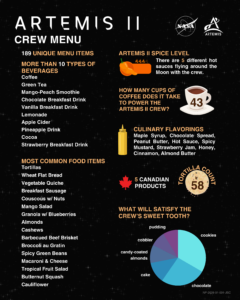
Designing food systems for NASA’s Orion spacecraft requires balancing nutrition, safety, and crew preferences while meeting strict mass, volume, and power constraints in a compact, shared cabin.
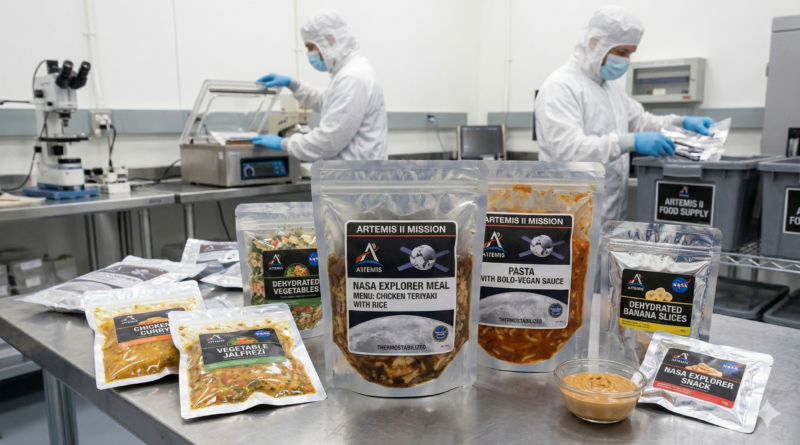
Here is a look at the unique packaging and logistical hurdles involved in supplying a lunar mission.
No Fridge, No Fresh Food, No Resupply for Packaging of Space food. Unlike the International Space Station, which benefits from regular cargo deliveries and occasional fresh ingredients, Artemis II relies on a fixed, pre-selected menu for a self-contained vehicle with absolutely no resupply. Furthermore, the Orion spacecraft lacks refrigeration and the “late-load” capability required to bring fresh foods aboard right before launch.
To overcome this, packaging must ensure that all items remain completely shelf-stable and safe. The menu relies exclusively on packaging technologies that support ready-to-eat, rehydratable, thermostabilized, or irradiated foods.
- Designing for Microgravity and Mission Phases. In space, a stray crumb is a serious hazard. All food items and their primary packaging must be engineered to minimize crumbs and particulates that could float in microgravity and potentially interfere with the crew or the spacecraft’s delicate systems. Additionally, the functionality of the packaging must adapt to specific mission phases and operational constraints:
- Launch and Re-entry: During these highly dynamic phases, Orion’s potable water dispenser is unavailable. Therefore, foods packaged for these periods must be entirely ready-to-eat.
- Transit: Once standard spacecraft operations are underway, astronauts can access the water dispenser to rehydrate freeze-dried meals and use a compact, briefcase-style food warmer to prepare their meals.
- Optimizing Volume with Smart Kitting. Because the mission faces severe upmass constraints that limit the amount of weight and volume that can be carried onboard, the packaging architecture must be incredibly space-efficient.
- To balance these strict limits with astronaut usability, engineers bundle two to three days’ worth of food for each crew member together into a single container. This intelligent kitting strategy not only optimizes storage but also provides the crew with some flexibility in their meal choices during the flight.
Ultimately, packaging for Artemis II proves that beyond simply protecting a product, our engineering directly supports human health, performance, and the success of deep space exploration.